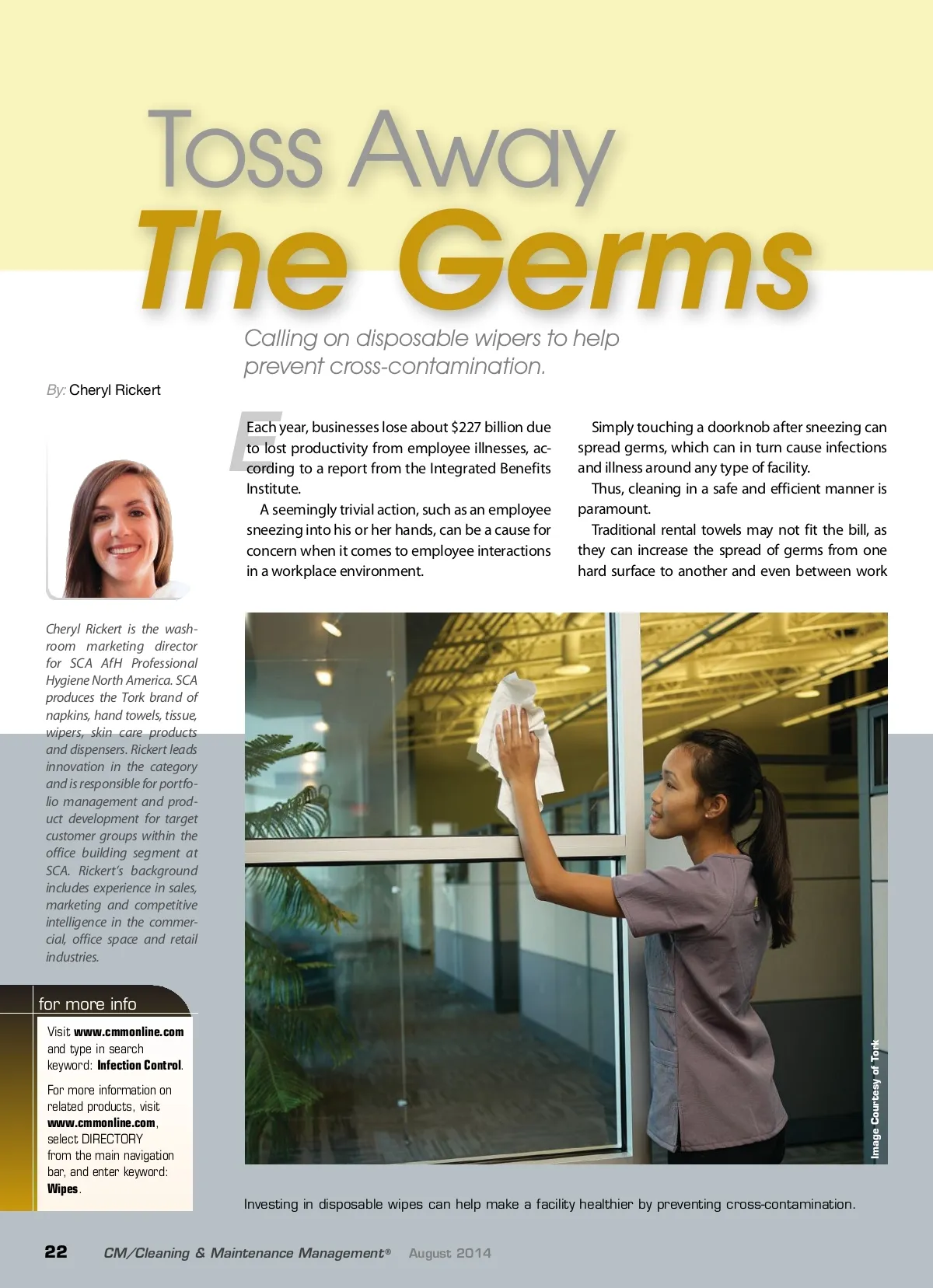
environments. Both in-house custodial professionals and building service contractors (BSCs) have a number of pain points related to cross-contamination, including health and safety issues, increasing efficiency and re-ducing costs. While it can be complicated to find a one-size-fits-all solution to these challenges, dis-posable wipers can effectively help address these problems. Addressing Health Issues According to the U.S. Centers for Disease Control and Prevention (CDC), the most common cause of skin infections in the U.S. is Staphylococcus aureus , or a “staph” infec-tion, which can result in illnesses ranging from small pustules on the skin to pneu-monia. Although these infections occur most frequently in healthcare facilities, they can cause illnesses outside of these environ-ments and are most frequently spread by direct skin-to-skin contact, touching shared items or touching surfaces that have been contaminated by an infected person. Custodial professionals and BSCs must focus on the prevention of cross-contam-ination by ensuring that surfaces are thor-oughly sanitized and disinfected — espe-cially those surfaces that are frequently touched, such as doors and elevator but-tons. In addition, with the growing trend of open office floor plans and shared office spaces, employees are more frequently ex-posed to shared surfaces. In fact, a study conducted by the Stress Research Institute at Stockholm University found that those who worked in offices with open floor plans took more time off for sickness. Consequently, it is even more essential for BSCs and custodial managers to main-tain high sanitary standards, as they adapt to the ever-changing work environment. Another Option While many facilities rely on the use of rental towels to clean and sanitize, BSCs and custodial managers may not realize that this practice could be exposing their colleagues and employees to outside con-taminants. When towels are sent off for laundering, facilities do not receive the same towels back from the laundry service. In fact, most rental towels are inter-changed between multiple settings, where they can become contaminated by bacteria from contact with other surfaces. When those dirty towels are washed, the contaminants mix into the wash water and can be re-deposited into towels that are re-circulated as clean. These contaminants can then be trans-ferred onto hands, and remaining bacteria can expose employees to various health risks. The even bigger concern is in employees using the same cloth for cleaning numer-ous areas. A recent study conducted by Dr. Charles Gerba, a University of Arizona microbiolo-gist, examined microfiber and cotton cloths used to clean hospital rooms — which are similar to those used in office buildings. What he found was that 93 percent of the laundered towels used to clean hospital rooms contained bacteria, including E.Coli . He also found that 67 percent of buckets used for soaking cloths with disinfectants were contaminated with bacteria. This study not only points to poor laun-dering practices, but also illustrates the need for managers to be even more vigilant about sanitation practices. Cleaning staff may also mistakenly take towels from different environments — such as from the bathroom to the work-space — thus increasing the risk for work-place-spread illnesses, as highlighted in Dr. Gerba’s research. While color coding towels can help to keep towels in their proper, designated environ-ment, disposable wipers are a an efficient and task-based solution for the workplace. A good solution is replacing rental towels with disposable wipers, which can mitigate concerns around repurposed towels as well as prevent bacteria from traveling from sur-face to surface. “Using a disposable wiper is the most hy-gienic option,” says Trevor Kelley, product manager at Tork, an SCA brand. “You get a fresh towel every time and can be sure that no outside contaminants have come into contact with that product.” Using disposable wipers doesn’t require specific employee training — just choose a wipe for a specific need, stock it in the proper environment and it’s ready for im-mediate, single use. Improving Efficiency, Decreasing Cost A key priority for managers is to maintain employee health and safety while improv-ing efficiency and cost control. Disposable wipers can help alleviate these pain points. With one-at-a-time dispensing options, BSCs and custodial professionals can easily grab a wipe for the task at hand and not have to worry about taking time to sort through an array of towels to choose the correct one. In addition, wiper dispensers keep the wipers clean, avoiding contamination from germs or liquids that could spill or spatter. They also provide controlled dispensing, which will help manage costs, as staff can grab only one at a time. “Task-designed wipers help create a more productive environment,” Kelley says. “When managers provide employ-ees with quick, easy-to-use alternatives for cleaning, which require minimum training, they not only increase safety, but also im-prove their bottom line.” Beyond health concerns, rental towels may not the best option for BSCs and custo-dial professionals in terms of cost efficiency. There are hidden costs stemming from laundering, including inventory fees and accidental/loss damage fees. In addition, incremental costs may result from the use of these towels. Wipers have no hidden costs, and know-ing the price upfront allows managers to choose the right wiper for the task and within their budget. Since cross-contamination is a concern that can greatly affect employee health and productivity, BSCs and in-house custodial professionals need to understand and im-plement proper cleaning techniques. For managers, this involves employee training and an overall awareness of market innovations. Proper cleaning and sanitizing will ad-dress both the perceived and actual cleanli-ness of a workplace. Ensuring a clean workplace in turn pre-vents illnesses and minimizes employee downtime. www.CMMOnline.com 23
CMM – Archives August 2014: 23